Use Case #7: Document Synthesis
How Claude synthesized discovery documents, PRDs, SOWs, and architecture specs into a single coherent client deliverable.
William Welsh
Author
Use Case #7: Document Synthesis
We'd been in discovery for 6 weeks. The result: 10 separate documents - requirements specification, PRD, SOW, HIPAA compliance blueprint, database architecture, AI/ML integration spec, third-party API documentation, security assessment, implementation roadmap, and risk register.
Total: 400+ pages of technical depth. The client wanted one document.
What Claude Did
Phase 1: Document Inventory - Read all 10 documents. Created a content map showing each document's pages, key sections, and overlaps with other documents.
Phase 2: Conflict Resolution - Found 7 inconsistencies: timeline in SOW didn't match roadmap, security requirements had two different encryption specs, database schema mentioned tables PRD didn't reference. Claude flagged each one, proposed resolutions, and applied them.
Phase 3: Structure Design - Created a unified outline: Executive Summary (new), Project Scope (from Requirements + PRD), Technical Architecture (Database + AI/ML + Security), Implementation Plan (Roadmap + SOW milestones), Compliance & Risk (HIPAA + Risk register), Appendices (API docs, detailed schemas).
Phase 4: Content Synthesis - Not just concatenation. Actual synthesis: removed duplicate sections, unified terminology, created cross-references, added transitions between sections, generated executive summary from scratch.
Phase 5: Output - Final document: 180 pages. Down from 400+, but nothing important lost.
The Impressive Part
Claude understood context across documents. When the security spec mentioned "AES-256 for data at rest" and the database spec mentioned "encrypted columns," it connected them and wrote one unified section on data encryption.
That's not copy-paste. That's comprehension.
Client Reaction
"This is the clearest technical document I've ever received."
They didn't know 400 pages went into it.
Try It Yourself
Copy this to synthesize your own documents:
I need to synthesize multiple documents into one coherent deliverable.

**Documents:**
1. How many documents are we combining? (list them or point me to a folder)
2. What's the target output? (executive summary / technical spec / client proposal / other)
3. What's the target length? (concise / comprehensive / specific page count)

**Handling:**
4. Should I resolve conflicts between documents? (yes, flag for review / yes, auto-resolve / no, preserve both)
5. Any specific sections that must be included?

I will:
- Read all source documents
- Map content and identify overlaps
- Flag and resolve inconsistencies
- Design a unified structure
- Synthesize (not just concatenate) content
- Generate new connective tissue where needed
- Output a single coherent document

What documents should I synthesize?
Prepared for a $250K project, January 2026.
William Welsh
Building AI-powered systems and sharing what I learn along the way. Founder at Tech Integration Labs.
Related Articles
View all →Use Case #15: Multi-Agent Schema Discovery
The database had 200+ tables. No documentation. No ERD. Claude spawned 5 parallel agents to map relationships, infer purposes, and generate complete documentation.

Use Case #1: Autonomous Bug Fixing from Slack
One prompt. Zero babysitting. Claude read bug reports from Slack, traced the issues through my codebase, fixed them, deployed to production, and verified the fixes in a browser.
Use Case #2: Client Onboarding from URL
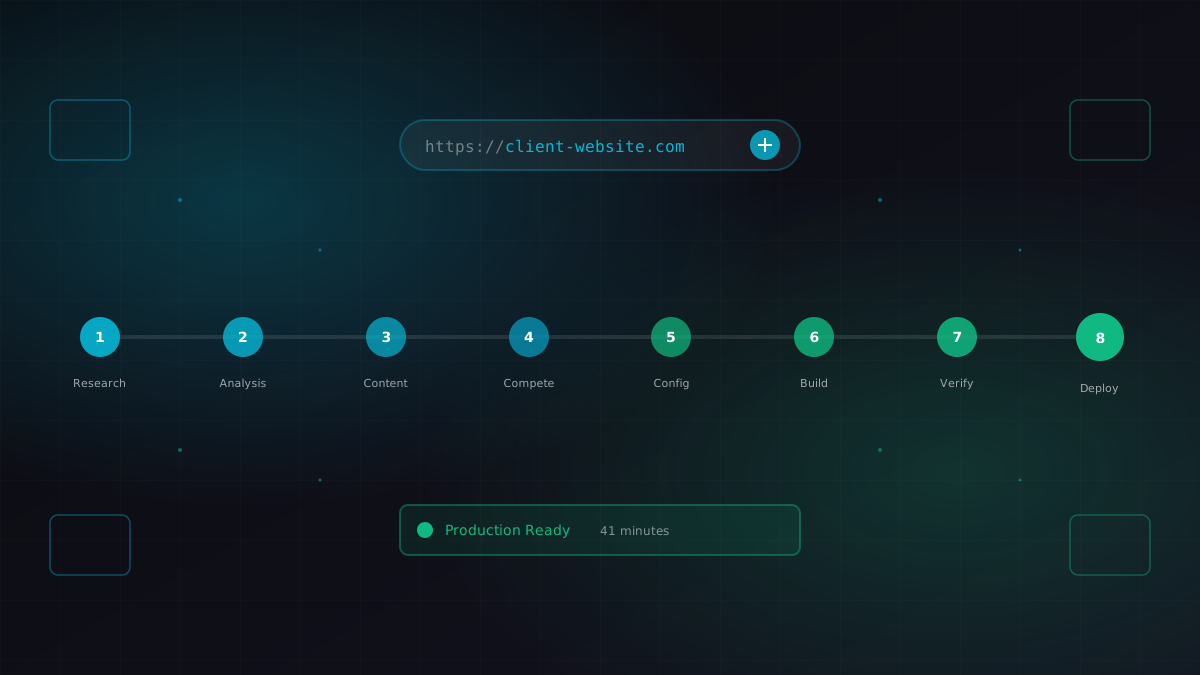
I gave Claude a business URL. It researched the company, scraped their content catalog, identified competitors, extracted brand colors, and generated a fully configured ContentEngine instance.