Use Case #8: Voice Notes to Specs
Converting rambling voice memos into structured technical requirements without losing the intent.
William Welsh
Author
Use Case #8: Voice Notes to Specs
I have ideas in the car. Used to lose them. Now I record everything.
The problem: my voice notes are chaos. Half-sentences, corrections, tangents, "actually no wait" reversals.
The Workflow
- Record voice memo while driving
- Transcribe (Whisper or Otter)
- Paste the mess into Claude
- Get clean specs out
Example
My input: "so I'm thinking about the onboarding flow and like... the thing is people get confused about... wait no actually the real problem is they don't know what to do first. So maybe we need like a checklist or... hmm... or maybe more like a progress thing? You know what I mean?"
Claude's output: A structured markdown document with Problem Statement, Proposed Solution, Requirements (progress indicator, next action clarity, skip functionality), Open Questions, and Acceptance Criteria.
What Makes This Work
Intent extraction. Claude understood that "you know what I mean" and "those things that show you" meant progress indicators. It filled in my gaps.
Contradiction handling. I said "maybe skip" then "wait that might be confusing." Claude captured both as a design tension to resolve, not a contradiction to ignore.
Structure imposition. My rambling became sections: Problem, Solution, Requirements, Questions, Criteria.
The Pattern
"Here's a voice note transcript about [feature/problem]. Turn this into a technical spec with requirements and acceptance criteria."
No cleaning needed. The messier the better - Claude works with raw thought.
Try It Yourself
Copy this to turn your voice notes into specs:
I have a voice note transcript to convert into a technical spec.

**Context:**
1. What's this about? (new feature / bug fix / improvement / idea)
2. What project does this relate to?
3. What output format? (technical spec / user story / PRD / requirements list)

Paste your transcript below (don't clean it up - raw is better).

I will:
- Extract the core intent from your rambling
- Identify requirements (even implicit ones)
- Capture design tensions and open questions
- Structure everything into a proper spec
- Add acceptance criteria
- Flag anything that needs clarification

Just paste the transcript and I'll handle the rest.
I do this 3-4 times per week. Hundreds of features have started as car rambles.
William Welsh
Building AI-powered systems and sharing what I learn along the way. Founder at Tech Integration Labs.
Related Articles
View all →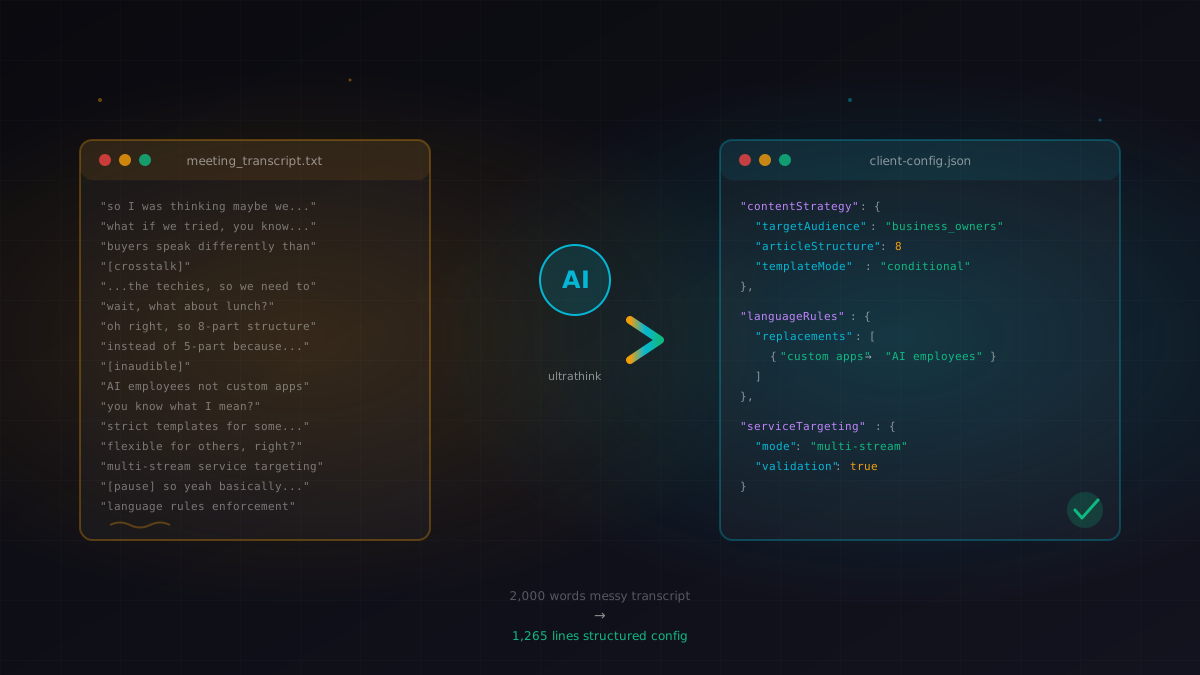
Use Case #3: Meeting Transcript to Code
I pasted a 10-minute meeting transcript. Claude extracted the strategy, identified the technical requirements, and modified a 1,265-line config file with conditional content logic.
Use Case #23: Voice to Proposal
I recorded my thoughts about a potential project while driving. Claude turned that rambling into a $45,000 proposal that won the contract.

Use Case #1: Autonomous Bug Fixing from Slack
One prompt. Zero babysitting. Claude read bug reports from Slack, traced the issues through my codebase, fixed them, deployed to production, and verified the fixes in a browser.